



Last week I introduced The Adaptability Trap — when the instinct to change overwhelms the instinct to lead — and how to avoid it by honoring core beliefs. (If you haven’t read Part I, I recommend doing so before reading this Part II).
Implicit in this framing is an obvious question: How do we identify our core beliefs and differentiate what to change from what to protect?
To make sense of this, I’ll tell you a story my hippie uncle told me (with much greater detail when I was far too young).
On the evening of July 3, 1973, Ziggy Stardust stood on stage at the Hammersmith Odeon in London for a concert that was the culmination of a more than yearlong, three-continent tour to promote The Rise and Fall of Ziggy Stardust and the Spiders from Mars.
As the show reached its climax, Stardust stood at the mic beneath a shock of crimson hair and announced, “Not only is this the last show of the tour, but it’s the last show that we’ll ever do.” In front of the stunned crowd, the band played their final song: “Rock ‘n’ Roll Suicide.”
The androgynous, interstellar “alien rock messiah” who had risen to global fame was no more. All that remained was the man beneath the makeup, David Bowie.
The persona of Ziggy Stardust had grown large enough to endanger Bowie’s real purpose: personal expression, creative sovereignty, and intimacy at scale. In ending Ziggy Stardust at the apparent zenith of fame, Bowie demonstrated his ruthlessness in separating his purpose — why he did things — from his ways and means — how he did them.
While it may have been difficult, by “killing” Ziggy Stardust Bowie preserved his core, created a path toward five decades of musical success, and avoided what I call The Ways and Means Trap: when the instinct to do the same thing overwhelms the instinct to do the right thing.
The Accelerating Pace of Change
As I wrote a few weeks ago, the costs to use AI (what we call inference costs) are plummeting; per-token prices have collapsed and ultra-low-cost models are becoming mainstream. On top of this, model performance continues to improve. Kimi K2 Thinking, an open-source model, now competes with, and in some instances exceeds, the capabilities of ChatGPT-5 and Claude Sonnet 4.5. AI is making experimentation and failure essential and accelerating the pace of change.
Last month, OpenAI reported ChatGPT had 800 million weekly active users, nearly twice as many as in February of this year. A recent McKinsey study shows that 88% of organizations now report regular AI use in one or more business functions, a growth of 10% from 2024. More than half of respondents reported experimenting with AI agents, and nearly a quarter are scaling agentic systems.
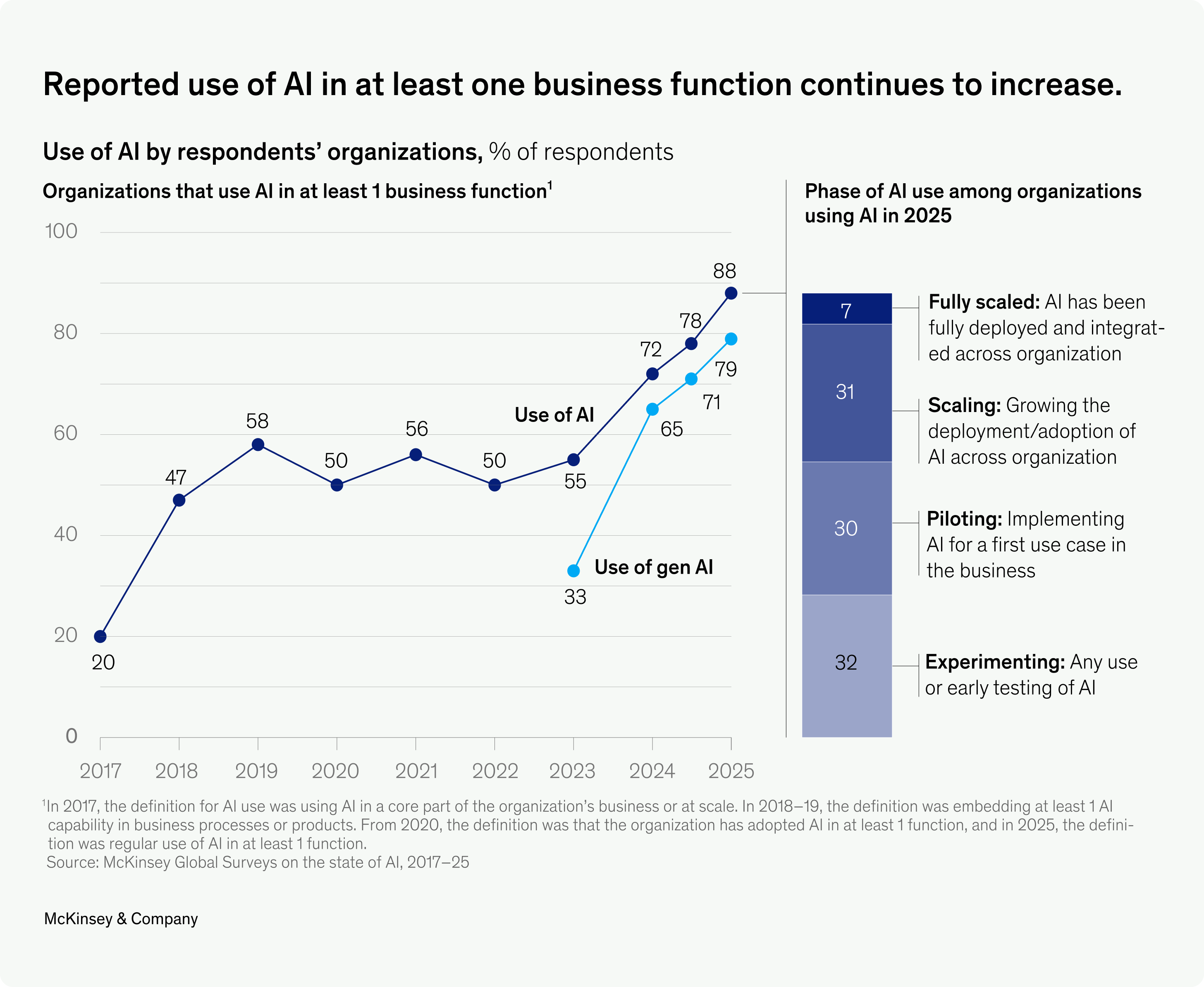
These are not small shifts or pilots; they are transformational endeavors. 21% of companies say they are using AI to fundamentally redesign workflows, and among “AI high performers,” about 50% intend for AI to transform rather than optimize their business. A global IBM study showed that executives expect AI-enabled workflows to grow from 3% to 25% by the end of the year. Already, 64% of AI budgets are spent on core business functions rather than experiments.
Across industries, AI is changing how work at the individual and structural level is done.
The Place for Purpose
Amidst this change, companies are increasingly talking about, and pointing to their purpose as a means of recruiting, press, and even growth. A corporate purpose serves (performatively or otherwise) as the company’s North Star for decisions regardless of circumstances or challenges. The definition of purpose can broadly be expanded to include mission, vision, and values.
Delta Air Lines’ mission is “to connect the world.” Biotech company Illumina’s vision is “to provide access to genomic medicine for every patient in need.” Nike’s mission is “to bring inspiration and innovation to every athlete in the world.” Walmart’s purpose is “saving people money so they can live better,” while UPS says theirs is “moving our world forward by delivering what matters.”
Whereas purpose is the why, ways and means are the how: everything from strategies, people, processes, tactics, and tools.
We are entering a chapter in which, I think, a K-curve will emerge as companies sort by those committed to their purpose vs. those committed to their ways and means.
I won’t over-editorialize a familiar story, but in 2002, while owning 90% of the non-theater entertainment market, Blockbuster’s mission statement was “to be the global leader in rentable home entertainment by providing outstanding service, selection, convenience and value“. They had confused their purpose with their ways and means. By 2007, they had lost almost all of their market share to Netflix which realized that DVDs and return boxes were discardable in the pursuit of their purpose, “entertaining the world”.
Today’s professional services organizations are at a similar inflection point. So much has been made of the demise of management consulting, for example. Quite candidly, I think the bet against these companies might be a good one, but not because AI is obviously going to eliminate the need for strategy consulting. I think the bet against these companies is fair because many of them will prove to be rigidly committed to their ways and means.
Despite mission statements like “to help our [McKinsey’s] clients make distinctive, lasting, and substantial improvements in their performance,” I think the partnership model (in which most of these firms are organized) will prevent them from investing in products and systems that would provide super-linear efficiencies to accomplish their mission. I think some of the famous consulting firms will rent associates on a per-hour basis until the last client signs a contract, in much the same way that the last Blockbuster still offers DVDs to the handful of families in Bend, Oregon, who want to rent them.
Upstart and adaptable professional services companies will maneuver past the legacy players by combining AI and human services to offer more innovative products and bend pricing models to provide step-function improvements in value and economics. Their missions will sound the same; their ways and means will be very different.
If your identity feels threatened by technology or market shifts, you’ve mistaken your ways and means for your purpose and fallen victim to the Ways and Means Trap.
The Ways and Means Trap affects more than just companies, though; individuals experience it as well. In each of our lives, professionally and personally, it is crucial to identify our own purpose.
This could be “to be a teacher” (Oprah Winfrey), “making people happy” (Walt Disney), ”becoming the heavyweight champion of the world” (Lennox Lewis), “being funny, on my own, in a room full of strangers” (Jerry Seinfeld), or any other number of noble personal pursuits.
When individuals identify purpose, they, like companies, can continuously develop the ways and means to best pursue it, and adapt them through waves of change.
To everyone reading this, if your identity feels threatened by technology, you may have mistaken your ways and means for your purpose, and fallen victim to the Trap. To work your way out, try to identify what your purpose is, and then consider how technology can help you amplify it.
Doing, Not Saying
The modern corporation is eager to proudly state its purpose, mission, vision, and values. But CEOs rarely get hired and fired for their commitment to the mission. When it comes to making tough decisions, capital returns often take precedence.
Companies are often bound to established and increasingly inefficient ways and means that prevent directional adaptation. Actual commitment to, and investment in, purpose allows leaders to experiment.
Individuals and businesses can test theories, do deep research, pivot from negative results, and explore improvements without exorbitant costs or company-wide buy-in. These experiments, across departments, industries, employees, and methods, become more accurate and actionable as they can all be judged against the same criteria: Does this advance our purpose?
This opens the door for leaders and companies to broaden the scope of how they operate and serve customers, including entering adjacent industries, evolving workflows, and developing entire new verticals of products and services.
How might “connecting the world” look when leaders are able to consider new modes of transportation beyond airplanes? How could “access to genomic medicine” be better realized with AI-enabled experiments and medicine development? How could a company better “save people money” when supply chain models, product suggestions, and delivery methods can all be reconsidered? So long as companies follow the through line — advancing purpose — the vectors of productive opportunity widen.
The Freedom of Purpose
When leaders anchor the why and interrogate the how, they unlock Bowie’s kind of freedom — the confidence to retire past success, protect the work that matters, and continuously experiment. Individuals and companies that do so turn Behavioral Adaptability into an advantage, and avoid both the Adaptability Trap and Ways and Means Trap.
Employees gain real agency and permissionless autonomy to adapt toward purpose. Agreeableness becomes obvious and incompatible with the work required to stay current and constantly improve. Teams can debate, run cheap experiments, abandon old methods, express differing views, and compound progress without losing themselves.
In an age of Unmetered Intelligence, this is how to make an advantage out of uncertainty. Abandon nostalgia, redesign systems toward the vision, let every change pull you closer to the mission, and at all times align yourself with authentic values.
Protect the purpose. Evolve the rest.
Visit zackkass.com to learn more about Zack and get in touch
You had me at "Bowie" What stands out here is the juxtaposition between adaptability and authenticity. Purpose, as you frame it, isn’t a brand exercise, it’s ballast.
Bowie’s “killing” of Ziggy wasn’t rebellion; it was alignment. He shed the persona to preserve the purpose. The same principle applies to companies navigating the AI revolution: tools and tactics will evolve at light speed, but clarity of mission becomes the only durable advantage.
It’s striking how even the world’s most adaptive organizations: Delta, Nike, UPS; rely on purpose statements that are static by design. In an age of accelerating change, constancy isn’t rigidity; it’s strategy.
I especially liked the callout on professional services. Overall, it’s a brilliant and timely reflection on how real leadership protects purpose while evolving everything else; and the Bowie analogy perfectly captures the courage to let go of past success to stay authentic and relevant.