

Linguistic Function
Historically, learning a new language was an exercise in necessity.
Merchants navigating the Silk Road mastered dialects from distant regions to broker trades and build relationships. Roman officials learned Greek, ensuring smooth governance over eastern provinces. Renaissance scientists studied Latin and Arabic to unlock collaborations that transformed medicine, mathematics, and astronomy.
In an era when commerce and knowledge flowed along linguistic lines, multilingualism was power. Those who spoke multiple languages held the keys to untold opportunities, while monolingualism walled off entire worlds of information.
Yet becoming multilingual was reserved mostly for merchants, missionaries, diplomats, and the wealthy, those who could afford extensive travel or private tutors. Fluency required immersion abroad or personal instruction, barriers that placed second-language mastery firmly out of reach for most people.
Fast forward 1,000 years, the global economy now operates in English and Chinese. Together, English and Chinese speakers control over 40% of world GDP. Individuals with strong English proficiency in non‑native countries earn 30–50% higher salaries than peers with lower proficiency. Speaking one or both of these languages ensures a chance at economic prosperity, while not speaking either meaningfully limits opportunity.
The End of Language Barriers
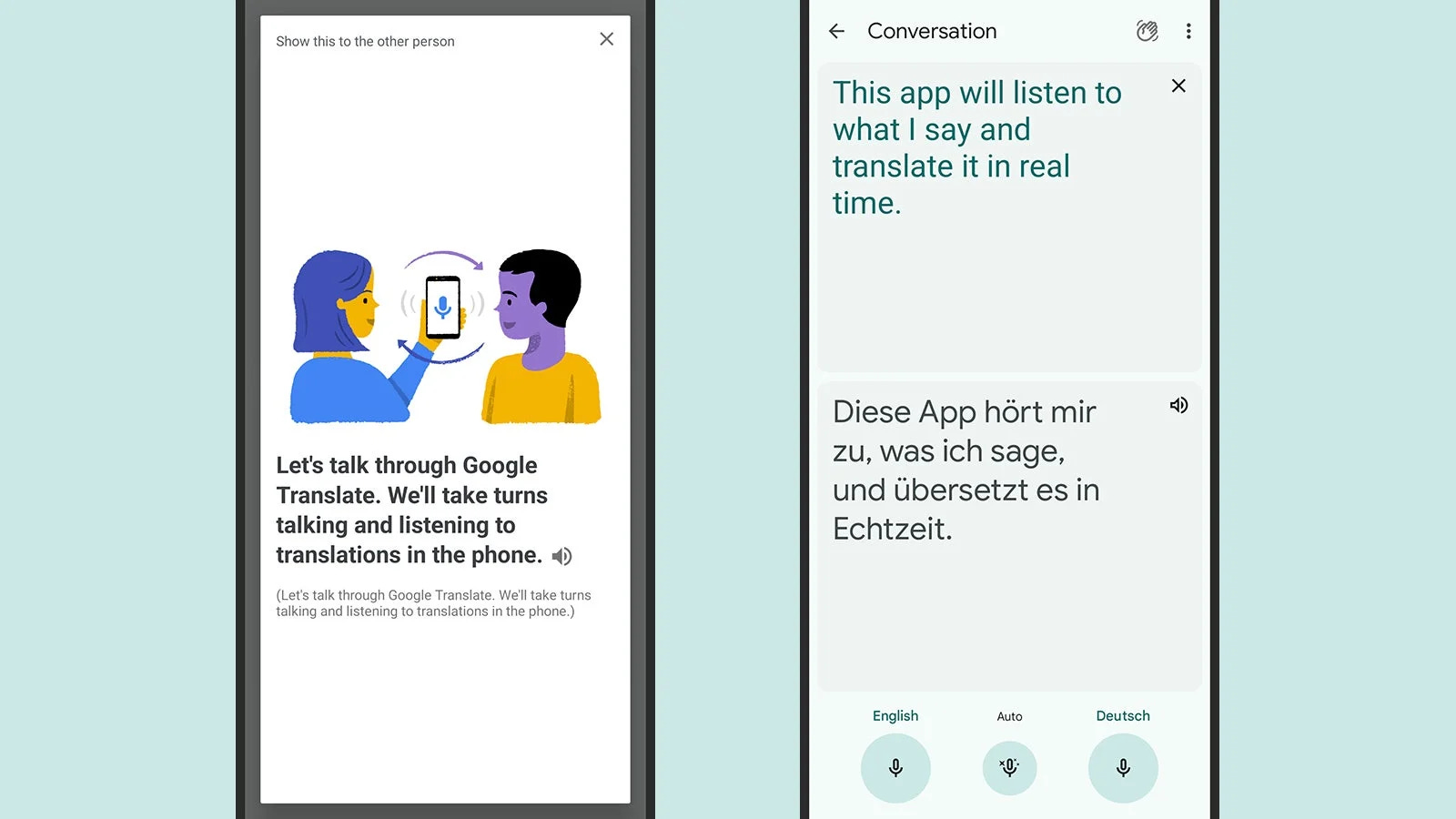
Real-time translation powered by AI is tearing down the final linguistic barriers to economic opportunity. Available via smartphone apps and handheld devices, real-time translation topples the practical linguistic barrier, allowing two people to seamlessly communicate without speaking the same language.
The Google Translate app has integrated AI capabilities, enabling users to receive real-time translation of spoken conversations and written words captured with phone cameras. In 2024, Google added 110 new languages using AI (including regional languages like Bashkir and Chechen), multiplying the number of potential linguistic combinations.
Dedicated tools like Timekettle’s T1 Translator represent a specialized approach to machine translation. The T1 is a handheld device that intakes user speech and outputs the translated audio accompanied by written transcriptions. Unlike smartphone applications, the T1 is 30% more accurate and can be used offline in rural and remote areas.
Ideally, future hardware will allow for seamless integration into daily life via ear pieces and other wearable components that audibly and reflexively translate foreign language.
The trajectory of this technology is indicative of a world where language no longer serves a purely pragmatic purpose. People will never need to learn another language. Traveling to exotic countries will no longer be dependent on obtaining a local guide. Businesses will be able to ensure that the best service is delivered agnostic to linguistic limitations. In-person translation services will be obsolete and antiquated, replaced by a plethora of machine translation technologies.
Implications of a Language Abundant World
Primarily, individuals in non-native countries are now included in the global economic equation. The expanded talent market enables all individuals around the world to earn high wages, not only those who speak English and Chinese.
Beyond the economic impact of eroded language barriers, the implications are twofold: (1) we can restore low resource, rare, and extinct languages and (2) we can pursue language for intrinsic purposes. By “solving” language, AI frees bandwidth for humanity to redefine its relationship with language.
Language Preservation
Spoken and written languages are compiled into large data sets to train machine translation tools. In turn, they become digital “relics” that can be used to preserve languages with dwindling speaker populations.
The Living Dictionaries Project by the Living Tongues Institute is a multimedia digital platform designed to preserve endangered languages by providing a “digital home” where they can be documented, shared, and experienced online. Using AI technologies, such as automated transcription and pattern recognition, the initiative empowers community members and linguists to efficiently build dictionaries composed of audio and visual artifacts. With over 400 dictionaries and more than 143,000 entries, the project harnesses AI as a widely replicable "teacher," enabling communities to sustain and celebrate their cultural heritage, divorced from any economic or educational motivations.
Similarly, OpenAI’s partnership with the Icelandic government and Miðeind aims to protect the nation’s native tongue amid increasing English dominance. The initiative focused on training GPT‑4 with high-quality Icelandic datasets from more than 40 local volunteers to improve grammar and cultural accuracy. This collaboration enhanced GPT-4’s Icelandic fluency and enabled applications ranging from Embla, a local voice assistant, to Icelandic chatbots on company websites. Making these tools available in Icelandic helps ensure that citizens can engage with AI in their own language, preserving cultural identity and minimizing the “AI divide".
Language for Fulfillment
Apart from those with ethnic ties to a language, AI is fueling people’s innate desire to engage with language. In 2023, 86% of adult learners claim that internal curiosity and enjoyment drove them to learn a new language. More granularly, this motivation can be attributed to a few reasons:
Cognitive Benefit: Speaking another language entails thinking in another language. This produces the side effect of improved cognitive function. Learning a new language increases the volume of gray matter in the brain – integral tissue for information processing, especially in aging individuals. In 2024, 26% of Baby Boomers admit they learn new languages to support their brain health.
Aesthetic Appreciation: Separate from practical mastery lies pure enjoyment of the beauty, rhythm, and aesthetic qualities of language itself. Prior to widespread AI usage, appreciating the literary qualities of a language was reserved for natives or those who studied the language in-depth. As people learn languages more quickly and effectively alongside AI-tutors, aesthetic nuances in language will become more prominent, altering newfound speakers’ appreciation of the language. This may lead to experimentation with multilingual poetry, music, and other art forms.
Social Connection: Polyglots actively acknowledge the interdependent nature of personality and language. Speaking an international friend’s native language allows you to understand personal complexities that your shared language may not transfer.
Previously, people were unable to explore language for internal reasons unless they explicitly dedicated their career or education towards it. We are lucky to exist at a time where language is pursued independently of its mechanics.


Thinking in More Languages = Broader Worldview
Like other tools that served purely economic purposes, language will soon serve primarily cultural purposes. As language is explored beyond its function, the multilingual global base will grow. People will develop an exceptional interpersonal understanding of one another with the second-order effect of expanding our ways of thinking and believing. In turn, collective perception of the world will soften, shaped by exposure to diverse perspectives and cultural nuance.
This is a return on a societal investment in technology that expands both our physical reach and intellectual capacity. AI in language is only one example – other facets of life remain untapped.
Your analysis overall historically makes sense. But as a bilingualism who uses ASL and English which are 2 separate mediums, I fear a bit of language loss if the only focus is on auditory/speech language and not visual/manual ones. You did provide me a bit to chew on.
Since subscribing recently, I have truly enjoyed how simultaneously positive, inspiring, provocative, and confident these Zack Kass posts are. I hope these AI guys end up making machines that can (actually, completely, accurately, effectively) do even just 5% of the shit they say they'll be able to do in my lifetime. Seems like a magical fantasy free $$$ world for everyone, and I love reading about it!!