


A 7,000-word piece of fiction moved the Dow 822 points
On Monday, February 23, 2026, the Dow Jones Industrial Average fell 822 points. Datadog fell more than 9 percent. IBM had its worst single-day decline since 2000, down 13 percent. American Express, KKR, Blackstone, Apollo, DoorDash (companies named or implicated in the essay) sold off in concert. The Wall Street Journal ran a piece that afternoon attributing the drawdown, in part, to a 7,000-word piece of fiction published the day before by an investment research outfit called Citrini Research. It was titled The 2028 Global Intelligence Crisis, and was written by an author most of the country had never heard of.
The piece is structured as a fictional macro memo dispatched from June 2028, looking back on the unraveling. The authors are quite explicit, in the opening paragraph, that what they wrote is a scenario, not a prediction. But the markets did not treat it like fiction.
Within forty-eight hours, Noah Smith, Citadel Securities, Ben Thompson, Derek Thompson, and a number of other credible commentators had weighed in with rebuttals. None of them, in my view, address the more interesting question:
Why did this piece of fiction grip the popular imagination and move markets?
Citrini’s central claim is sharp: “For the entirety of modern economic history, human intelligence has been the scarce input… We are now experiencing the unwind of that premium.” It is my belief that that is the sentence that took 822 points off the Dow.
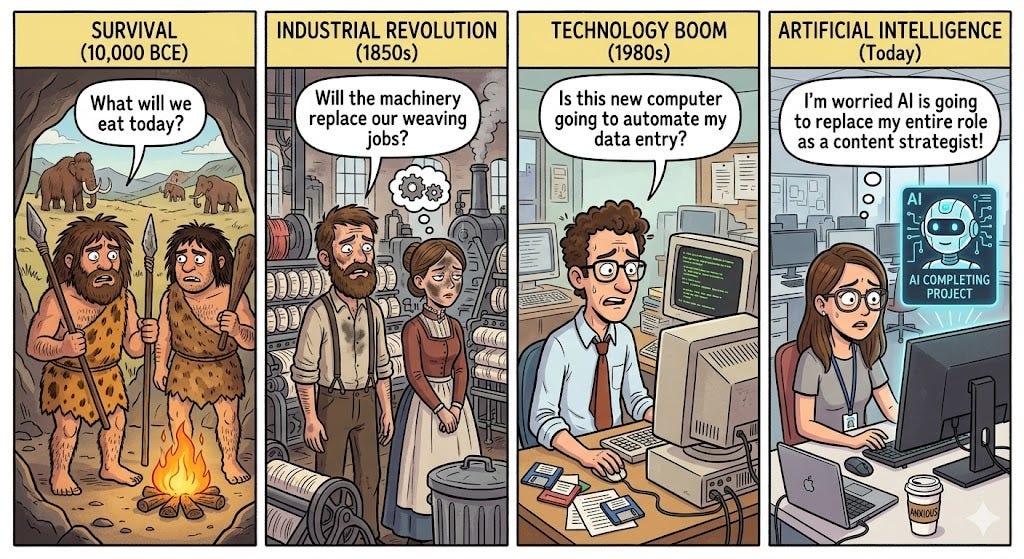
The piece resonated because it did something most of the AI discourse refuses to do, which is describe, in vivid and specific detail, a world where the problems that entire professions were built to solve — the problems people have organized their identities around — are simply no longer problems. That is what scared people. Not the automation of one task, but the retirement of the entire underlying problem.
That fear is real, and it is also misplaced. It’s real because the obsolescence is real. It’s misplaced because the people frightened by it are responding to the wrong feature of the world. They think they’re afraid of losing their jobs. What they’re actually afraid of is losing the problems their jobs were built to solve — and the identities they built around solving them.
Jobs exist to solve problems
Every job exists because someone has a problem worth paying to solve.
Problems create jobs. Jobs create roles. Over time, the work becomes familiar. The role becomes legible. And eventually, the problem the job exists to solve starts to feel like a stable feature of the world. Something we expect to find there when we wake up tomorrow morning, the way we expect to find the kitchen. Eventually, we stop seeing the problem and start seeing the profession, which means we can’t imagine a version of ourselves that isn’t defined by solving it.
And yet, problems are not static. They never have been, and never will be. Human progress is, at its core, the story of graduating from one set of problems to the next.
For most of the twentieth century, “computer” was a job title. It described a person (usually a woman) who performed mathematical calculations by hand. NASA had hundreds of human computers. The Harvard Observatory ran an entire team of them. They worked at firms across finance, engineering, and government. The job was a real job. It paid a real salary. It came with the same identity-bearing weight that any white-collar profession does today.
The job didn’t just go away. The category of problem (manual calculation as a scarce resource) was solved. The problem graduated. The identity attached to the problem could not.
If you’d asked a human computer in 1960 what she’d be doing in twenty years, she would have been right to be afraid of the answer. If you told her further that nobody in 2026 spends a moment of their life worrying about her vanished profession, she would have been bewildered. How could the world simply forget a kind of work that had once felt as fundamental as accounting?
The answer is that the world is in the business of retiring problems and forgetting they were ever problems at all.
We are, every one of us, the descendants of people whose problems graduated.
Every era’s scarce input
Every era’s economy is built around a single scarce input. Land was the scarce input of agrarian society. Own enough of it and you owned everything else. Manual labor was the scarce input of the early Industrial Revolution. The entire architecture of modern labor law was built to manage its allocation.
Capital was the scarce input of the postwar period. We built the modern financial system around its mobilization. Each of these eras built its institutions, its politics, its mortgage markets and tax codes around the assumption that its particular scarce input would remain scarce forever.
Each was wrong.
Citrini’s central claim, that human intelligence has been the scarce input of modern economic history, and that AI is now eroding the premium that scarcity created, is correct.
What’s wrong is the framing. The unwind is not a unique catastrophe, it’s a pattern. The same thing happened to land, to manual labor, and to capital. It’s how civilizations graduate.
What Keynes saw coming in 1930
In 1930, John Maynard Keynes wrote a short essay called “Economic Possibilities for Our Grandchildren.” I have it framed in my office. He was writing in the early years of the Great Depression, with U.S. unemployment climbing fast on its way to a peak of nearly 25 percent, breadlines forming in every major American city, and the global financial system in active collapse.
Against this backdrop, he made an argument that no one else was willing to make. Keynes argued that humanity was within roughly a century of solving what he called “the economic problem” — the long, grinding struggle for subsistence that had defined every prior era of human existence. And, that the central question facing the descendants of his generation would not be how to survive, but how to live well once survival was no longer in question.
Keynes wagered that boredom was going to be our biggest problem.
He was, broadly, right. But he was wrong on the timing. We are 96 years into his 100-year window, and the economic problem is not solved, only dramatically reduced. He was also naive about the distribution: the benefits have been wildly uneven. But the deeper argument he made, the one no other major economist of his era was making, has held up.
The problems we worry about today are made possible by the graduation of problems we no longer worry about. Boredom, identity, meaning, purpose… these are the problems of people who no longer wake up wondering whether they will eat. Maslow mapped this for individuals, but civilizations do the same thing collectively.
Consider the original problem: feeding oneself and one’s family. Prior to the development of sedentary agriculture, human groups were limited in size, and to a first approximation, everyone’s primary job was finding food. The most basic evolutionary problem — finding food to survive and procreate — consumed functionally all available human labor.
Over time, agriculture generated food surpluses that allowed for the development of larger and more complex groups, and ultimately gave rise to occupations to handle that complexity. Skipping forward a few thousand years, humans developed bureaucracies, classes of administrators, scribes, accountants, lawyers, and eventually compliance software companies. The solution to the problem of feeding oneself created new problems, which created new jobs, and new identities.
We would not want this any other way. A world stuck with the current set of problems is a world without progress.
What graduation looks like
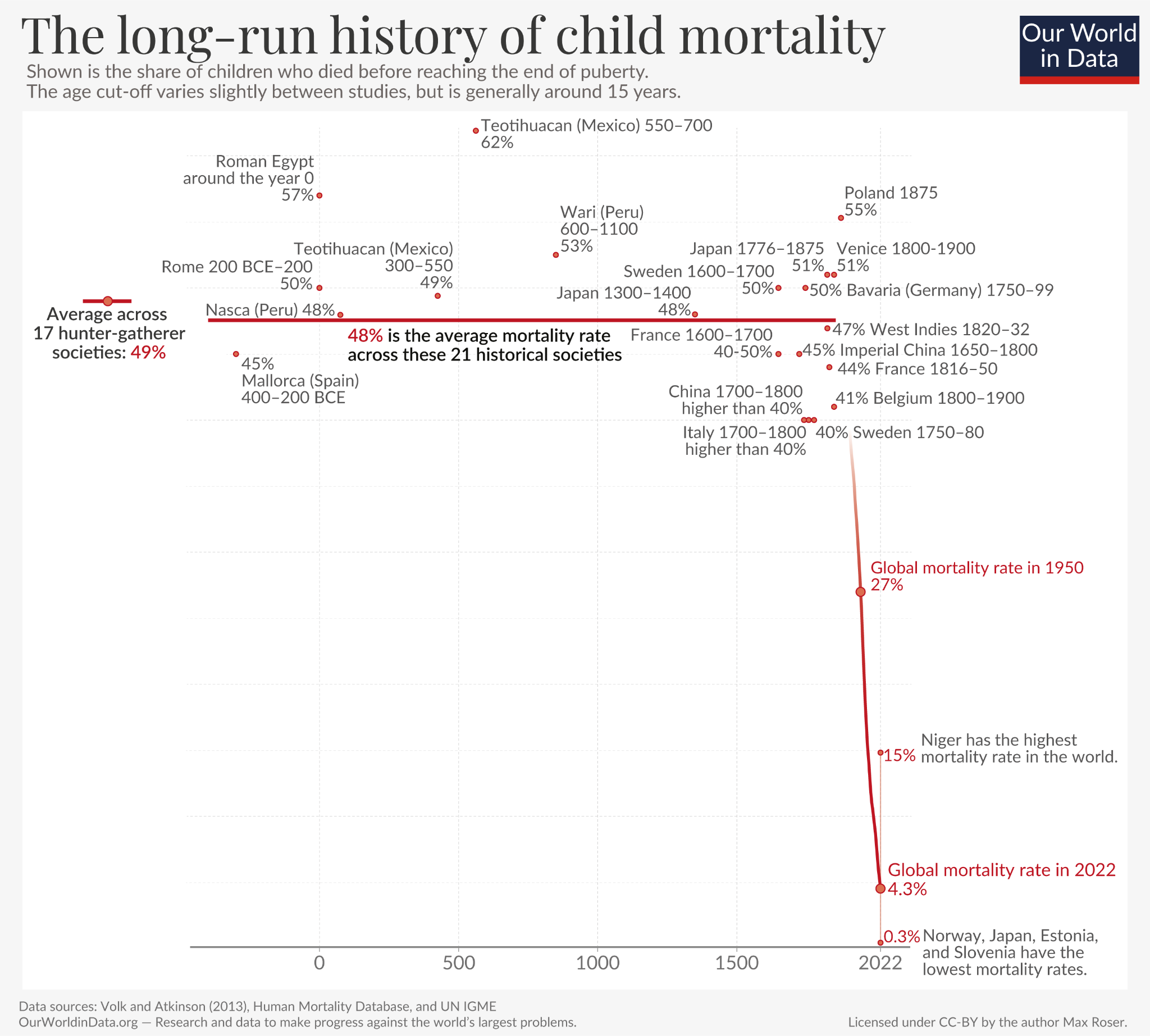
Most of us know we live longer and richer lives than our great-grandparents. What’s harder to understand is how dramatically the category of problem we worry about has shifted. Even after agriculture transformed humanity’s relationship with food, famine remained a recurring fact of life. Crop failures, war, and catastrophic policy decisions could still starve millions.
The largest famine in human history was the Great Leap Forward in China between 1958 and 1962, with an estimated 36 million deaths. Globally, famine deaths in the past four decades amount to roughly 6 percent of the pre-1970 total, despite the world’s population having more than doubled. Famine today exists almost exclusively in active war zones and failed states. It is no longer a feature of the world. It is a symptom of state collapse.
We worry instead about obesity, ultra-processed food, metabolic disease, and food waste. These are graduate-level food problems. They are real. They are also problems that would have struck a 19th-century European peasant as a kind of cosmic joke.
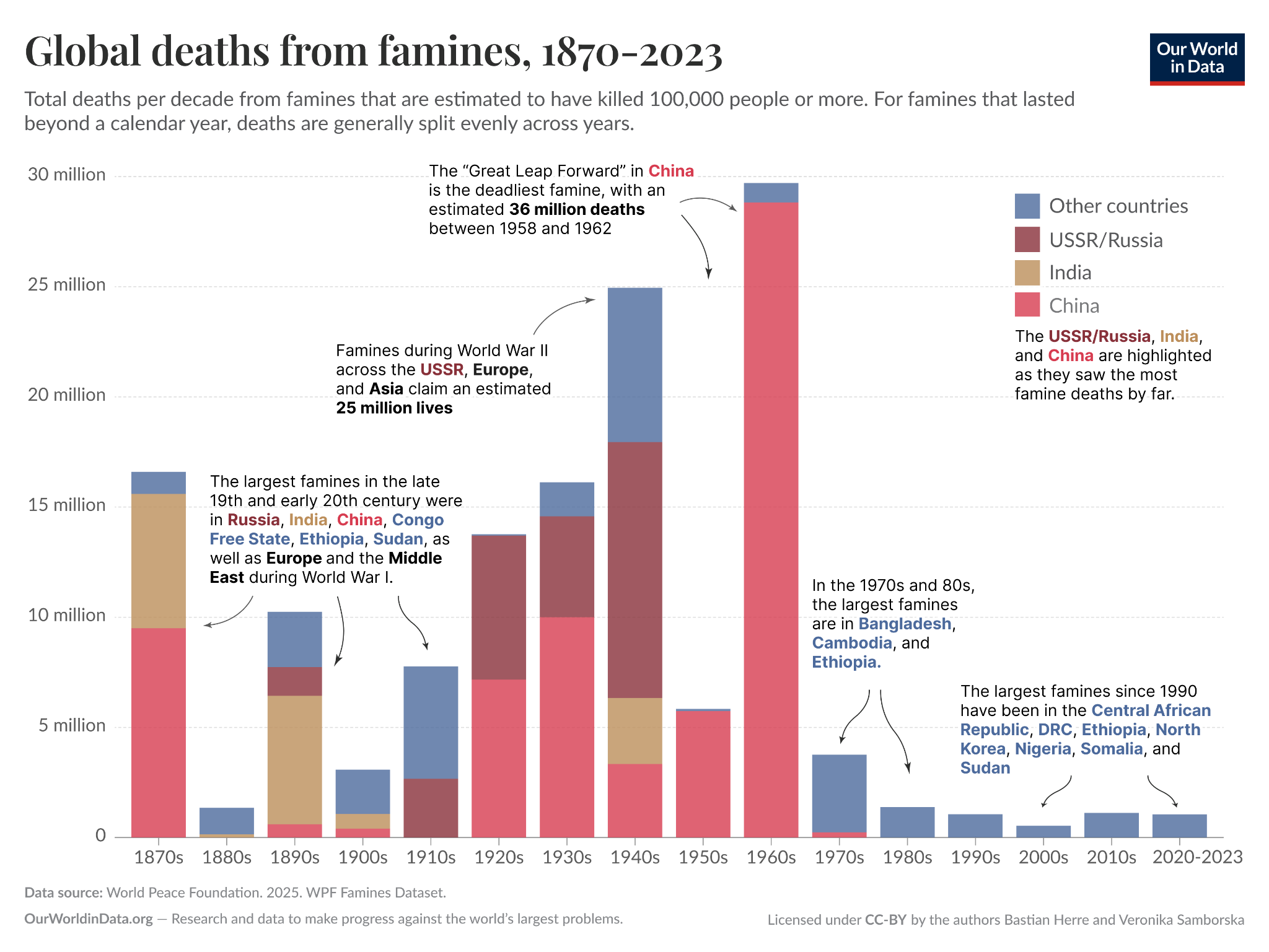
Childhood mortality has followed a similar trend. In 1800, more than one-third of children died before the age of five. The average woman had between five and seven children, and the expectation (not the fear, the expectation) was that two or three of them would not survive. Read 19th-century novels and you will notice how many children die. The novels were not sentimentalizing. They were describing the world.
By 1950, that figure had fallen to 27 percent. By 2020, it had fallen to 4.3 percent globally, and to roughly 0.4 percent (about 1 in 250) in wealthy countries. We have not eliminated the death of children. We have moved it from the central fear of family life to a tragedy rare enough that, when it happens, it is unbearable in a way that simply could not have been sustained as a constant feature of life two centuries ago.
Violent crime in the United States has run the same trajectory. The U.S. homicide rate peaked in 1991 at 9.8 per 100,000. As of 2024, the FBI’s Uniform Crime Report puts the rate at 5.0 per 100,000. That’s a 14.9 percent decline from 2023 alone, the lowest level in over a decade.
On average, the American city is dramatically safer today than the American city of forty years ago. Most people, including most of the people who live in cities, do not believe this because we are systematically overexposed to negative information and underexposed to positive information – and the news cycle has no incentive to correct the imbalance. But the data is not ambiguous. The streets are safer.
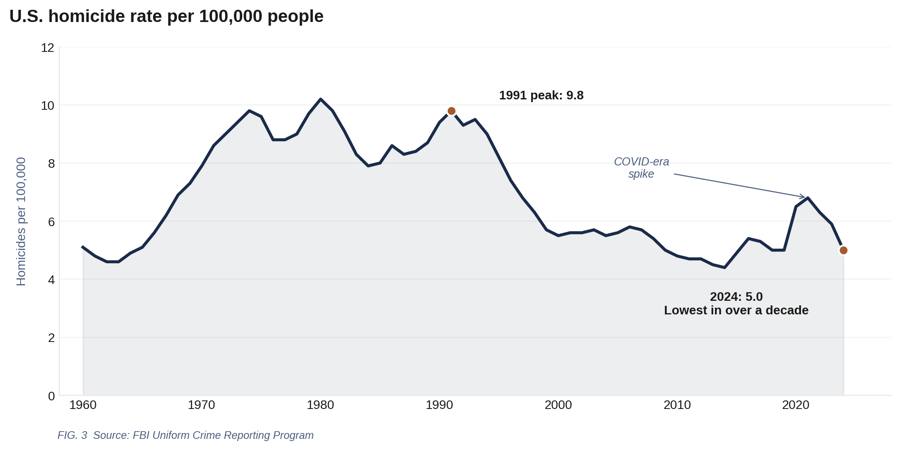
None of these are stories of completion. Children still die. Famine still kills people in war zones. These are not solved problems. But they are graduate-level versions of problems our great-grandparents faced. The question for our era (and the one the Citrini Report inadvertently raised) is whether the problems we worry about today are end-state problems, or whether they too are simply waiting for the next graduation.
A graduation that didn’t go well: the Rust Belt
We have a recent example of what it feels like to be on the wrong side of a graduation, in living American memory. The Steel Belt became the Rust Belt because the work the Steel Belt was organized around — the production of structural steel as a scarce input to industrial economies — graduated. Cheaper foreign producers, then automation, then a global supply chain that could route around any single national industry. The work didn’t disappear. It dispersed. The identity attached to the work did not survive the dispersion.
What happened next is well-studied, and worth taking seriously. Di Tella and Rodrik ran a 2019 NBER study on what kinds of policy responses people actually want when their jobs are eliminated by different kinds of shocks. The headline finding is: across nearly every type of labor-market shock (foreign competition, technological change, demand shifts, etc.), workers prefer trade protection to compensatory transfers.
They’d rather the government block the thing that took their job than receive financial compensation for losing it.
On October 1st, 2024, 50,000 dockworkers walked off the job along the entire eastern seaboard, shutting down half of the American import-export economy. Harold Tabb, the head of the union, went on CNN the next morning and said plainly: he did not want safer working conditions. He did not want higher wages — the two demands of every labor union since we organized labor. He wanted one thing: a guarantee that the ports would not automate their jobs.
We tracked down thirty of these dockworkers and asked them a few questions. Eighty-five percent said they believed they could find a job in another sector. Ninety percent had family members in the union. And the top-cited value of their work wasn’t wages. It was community. Their signs said “robots don’t pay taxes.” What they meant was: this is who we are.
This is why so much of the AI conversation routes around the actual mechanism of disruption and toward identifiable villains like the labs, venture capitalists, or founders. We are running the same psychological pattern the Steel Belt ran. We are looking for someone to put a tariff on, because the alternative is to admit that the problems we are organized around are graduating, and that we will have to graduate with them.
What the AI panic is really about
The reaction to the Citrini Report is not really about the recession the report describes, the specific stocks that fell, or the macroeconomic plausibility of the daisy chain Citrini lays out.
The reaction is about the half-conscious recognition that the underlying problems their work depends on may not be permanent features of the world. That the careers they have spent fifteen or twenty or thirty years building were always, secretly, bets on the persistence of a particular constellation of problems… and that the bet is now coming due faster than anyone expected.
The people feeling it are right that something is changing. They are wrong about what.
What is changing is not that humans will become economically unnecessary. That framing collapses the moment you pressure-test it. We are all the descendants of people whose jobs were automated, often within a single generation.
None of us spend a moment of our lives mourning the disappearance of those professions. We do not lie awake worrying about the fate of the lamplighter, the human computer, the elevator operator, the typesetter, the switchboard operator, the ice deliveryman, the telegraph clerk, or the linotype operator. The work moved. Humans kept finding new things to be paid to do, because humans kept finding new problems worth paying to solve.
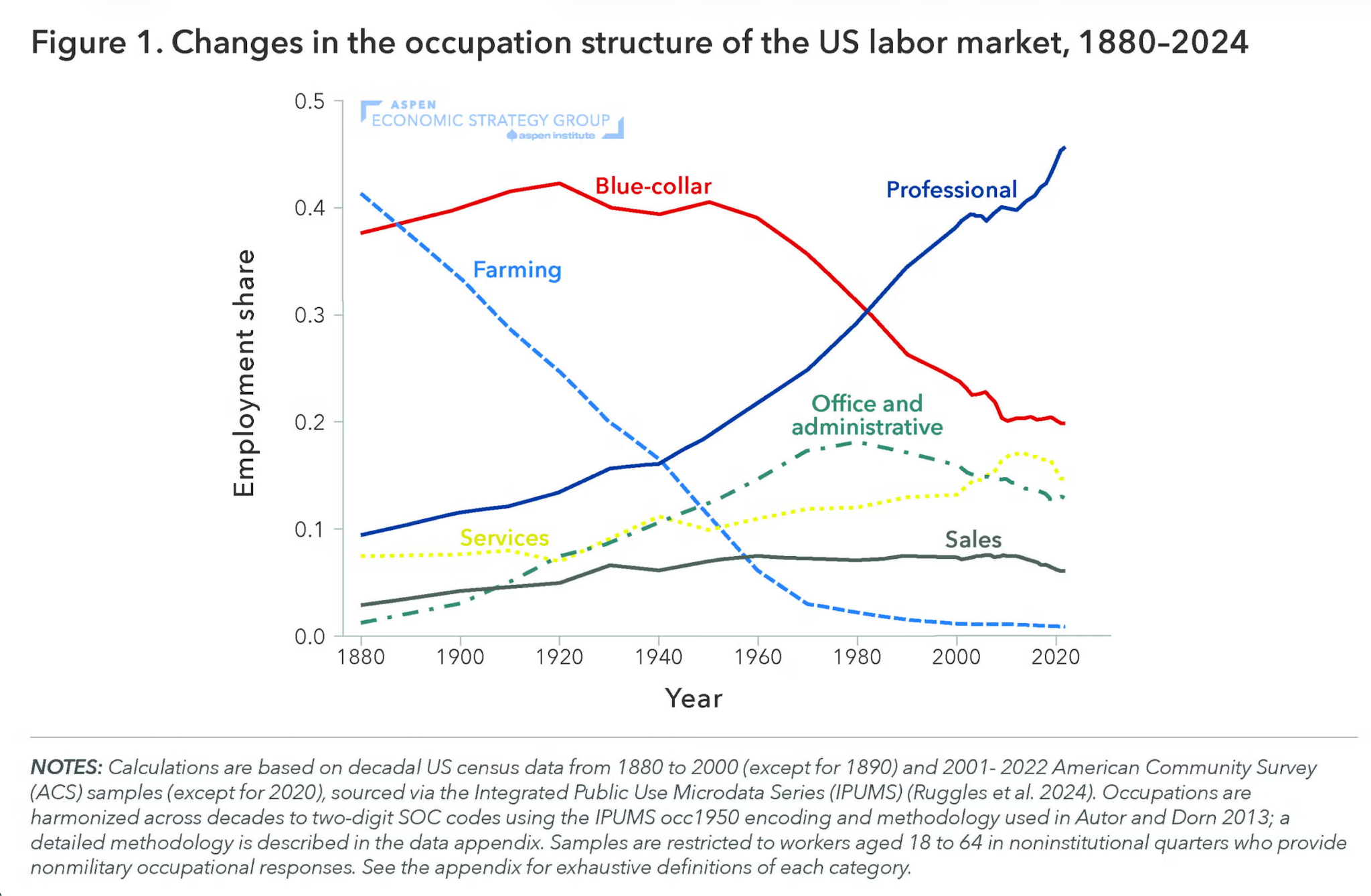
The Citrini Report scared its readers – the educated professional class that has spent two generations identifying with a specific cluster of problems: drafting documents, summarizing information, modeling cash flows, writing code, optimizing supply chains, generating marketing copy, screening résumés, building decks. That cluster is graduating, in real time.
The identity is being asked to graduate at a speed that no prior generation of professionals has had to manage. The Steel Belt got fifty years of warning. We got eighteen months.
That is the fear worth having. Not “AI will make me unnecessary.” That fear has the wrong subject. Humans have been needed in every era. Humans will be needed in this one. The right fear is more specific: the version of myself I built around the problems of 2015 may not transfer cleanly to the problems of 2030, and I have less time to handle the transfer than my parents had.
That fear is real, and the answer to it is not to declare AI an enemy and demand that it be slowed down by policy. The answer is to deliberately do what every prior generation has done more slowly: separate your identity from the specific problem you happen to be solving today, and re-anchor it to the underlying capacity that lets you solve problems in general.
Your work is not what you do. Your work is the friction in someone else’s life that you are paid to remove. The friction is going to migrate. The capacity to find and remove it is what will travel with you.
There is a version of this argument that says the disruption is temporary. A messy middle between the economy we have today and some post-AI abundance waiting on the other side.
I don’t think that’s right. Not because abundance won’t come, but because the messy middle is not an exception to the human story. It is the human story. Every era that has existed has been someone’s messy middle. We’ll get through this one, and on the other side there will be another set of problems worth having – harder to solve, more concentrated, and more human than the ones we’re losing sleep over today.
What this asks of you
#1: Audit your professional identity for the problem it’s actually solving.
What is the underlying friction in someone else’s life that your work removes? If the problem is graduating, your job is to graduate with it.
#2: Have empathy for the people who can’t.
Some of the people around you will not be able to do this gracefully. Some of them will get angry, and the anger will look ugly, and it will be tempting to dismiss it as ignorance or reaction. Don’t.
Their anger is grief. It’s the grief of people whose identities were quietly retired without their consent, by a process they did not choose and cannot reverse. That fear isn’t stupid. It’s exactly what every generation feels at the moment of graduation. We don’t have to indulge it. We do have to honor it.
#3: Separate your purpose from your ways and means.
Every prior generation that lived through a graduation has had the luxury of time. We do not, and we need to ask the question now: if you strip away the specific problem you happen to be solving today, what remains? What is the underlying thing you are good at, that you care about, that the world keeps needing in new forms?
When you stop organizing your identity around the task, you get access to the why underneath it — and that’s where meaning lives. What remains isn’t less. It’s more human than the version you were protecting. Protect the purpose, evolve the rest.
Work won’t disappear. It never has. It will only graduate.
And so can you.
• • •
Other thoughts to discuss at your dining room table:
Jonathan Haidt gave the commencement address at NYU last month and warned graduates that their phones were engineered to hijack their minds. And the kids proceeded to boo the man who fought Meta to save them from the device.
The AI conversation is taking on strangely theological tones. We have our prophets, our apocalypticists, our evangelists, and our doctrines of alignment and doom. We debate whether the technology will save us or destroy us as though the machine itself is the protagonist of the story. But software has no conscience, no moral responsibility, and no stake in the outcome. The people building it, deploying it, governing it, and using it do. The moment we start treating the machine as a moral subject, we begin shifting scrutiny away from the people who actually bear responsibility for its use.
I continue to ask audiences the same question: What is your Automation Boundary? If you could automate everything in your life, where would you stop? I’m eager to hear your non-obvious takes.
• • •
Quick favor to ask: If you enjoyed my book The Next Renaissance, would you consider leaving a short review on Amazon here?
Even a few sentences helps more than you think and makes it easier for others to find it. When you do, email me a screenshot of your review at book@zackkass.com. I’ll invite you to a private AMA where we can talk through ideas, questions, or anything the book brought up for you.
Visit zackkass.com to learn more about Zack and get in touch.
I really appreciate this perspective and articulation. Thank you for continuing to keep it real without the drama.
Love this, your best so far. This reminds us how every major era of human progress has been defined by a scarce resource that eventually became abundant. The printing press democratized knowledge. The Industrial Revolution democratized production. Radio and television democratized distribution. The internet democratized information. Today, as correctly articulate, AI is beginning to democratize intelligence itself. The fear many people feel, may not be about technology replacing jobs as much as it is about witnessing the graduation of problems that entire professions, institutions, and identities were built around. Just like what you share about the Longshoreman's Union leader.
What I found most compelling is the reminder that this pattern is not new. Human progress has always been a story of solving one set of problems only to inherit a new set. The question isn't whether change is coming, but whether we can separate our identity from the specific problems we solve today and adapt to the next ones. The observation that "every era that has existed has been someone's messy middle" is a powerful reminder that the AI era is not an exception to history, just the latest chapter in it. The question I keep coming back to is: if intelligence is becoming abundant, what becomes the next scarce and uniquely human source of value?