


There is an increasingly self-evident understanding that large government systems have become deeply inefficient and, in many cases, utterly ineffective.
A Government Accountability Office (GAO) report revealed that duplicative federal programs cost American taxpayers tens of billions annually, with $162 billion identified in improper payments in the 2024 fiscal year. At the state level, inefficiencies manifest in prolonged project timelines and excessive administrative overhead, with studies indicating that only about 35 cents of every state tax dollar directly funds essential services.
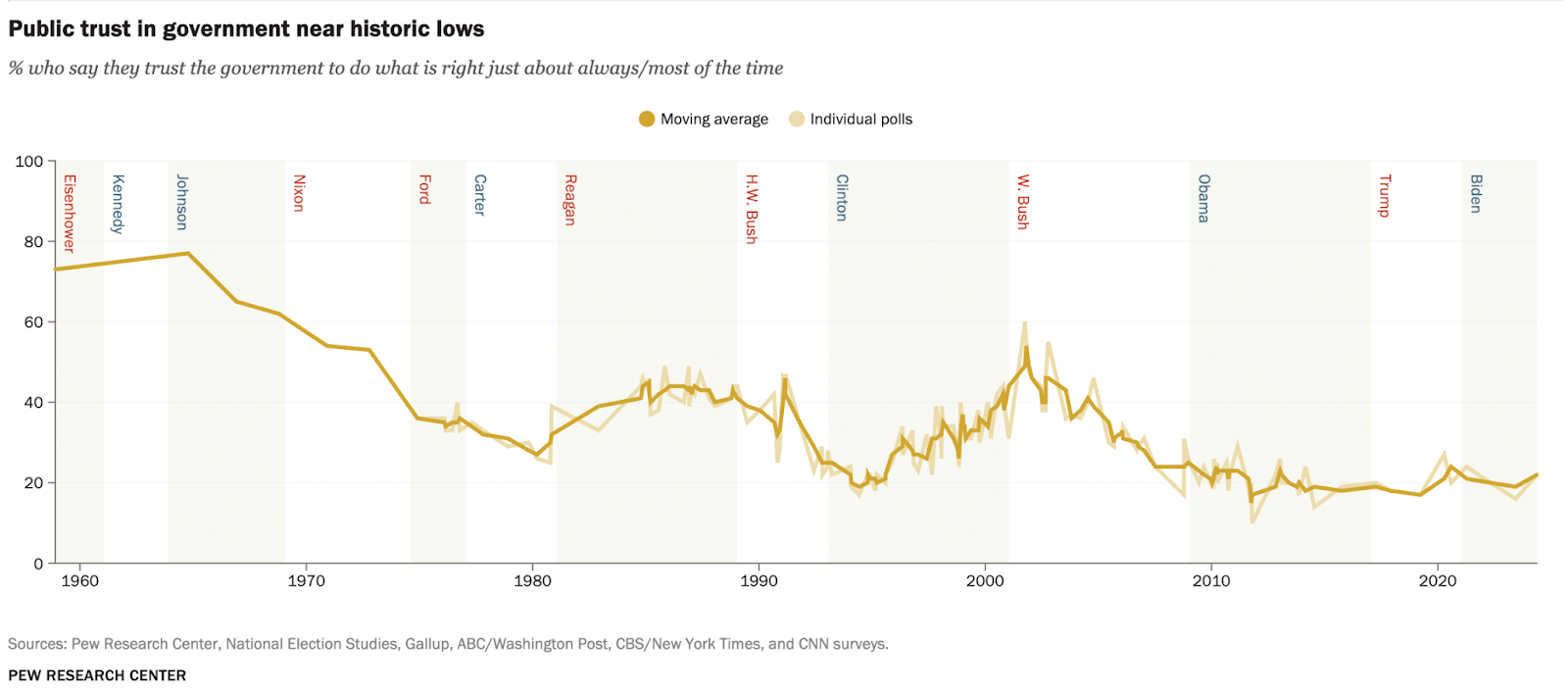
Globally, public trust in federal and state institutions continues to erode. Citizens confront the tangible consequences of these shortcomings daily, from delayed social services and dysfunctional infrastructure projects to crises exacerbated by sluggish responses. The root of these issues lies in sprawling bureaucracies and rigid regulations, making the most obvious solution, AI automation, feel impossibly distant.
Perhaps most critically, the public sector often resists automation due to a misalignment in incentives: automation threatens budgets and headcounts, traditional measures of governmental power and influence.
Yet local governments are uniquely positioned to buck this trend. Unlike federal entities, local governments operate with tighter budgets and limited personnel, demanding efficiency and innovation. They’re directly accountable to their communities, facing immediate pressure to deliver tangible results, and their simpler structures lend to more flexibility with technological upgrades.
Together, these conditions create an environment where local governments not only need but are uniquely suited to become early adopters of AI, serving as critical testbeds for broader public-sector innovation.
Why Government Needs a Reset
Government once represented our most powerful tool for collective progress, allowing us to build roads, schools, and safe communities. Yet today, scale and legacy systems have become burdens rather than benefits.
New Jersey’s unemployment system still relies on COBOL, a programming language introduced in 1959. In 2023, the state had to entice retired programmers back with six-figure salaries just to keep the outdated system operational. Meanwhile, disconnected data systems amplify issues. Illinois found that nearly 40% of food assistance recipients were incorrectly served because of fragmented databases incapable of communicating effectively.
These inefficiencies persist even as budgets balloon. Despite a record $6.3 trillion federal budget in FY2024, basic services remain painfully slow. Many government agencies struggle with limited staffing and operational bottlenecks, which further slow service delivery and contribute to mounting backlogs.
Local governments, however, are responding differently. With smaller budgets and fewer personnel, they are embracing innovation and agility. AI provides essential leverage, enabling the delivery of personalized, responsive services at scale.
How AI Is Already Transforming Local Government

AI is reshaping local governance through three powerful applications: policy modeling, constituent connection, and service automation.
Policy Modeling: Amsterdam is utilizing AI for urban planning by simulating the impacts of policy decisions on public safety and environmental sustainability before they're implemented. These predictive capabilities ensure smarter, more cost-effective outcomes.
Constituent Connection: Platforms like Go Vocal enable local governments to efficiently process and interpret resident input from various sources, including surveys and open-ended responses. This streamlined approach transforms citizen engagement by allowing officials to swiftly address vast amounts of feedback, strengthening public trust and community relationships.
Service Automation: Denver's AI-powered chatbot, Sunny, streamlines access to city services by handling 20–30% of inquiries around the clock, including tasks like scheduling DMV appointments, reporting issues such as potholes or graffiti, and providing information on city services. The automation of routine tasks reduces administrative burdens, allowing staff to focus on more complex, value-driven work
Service automation became especially critical in the wake of the 2025 wildfires in Los Angeles. To accelerate recovery, Rick Caruso’s nonprofit partnered with the state to deploy an AI-powered permitting tool that automatically checks building plans for code compliance, cutting approval times from months to days and helping residents rebuild faster.
A New Blueprint for Public Service
The transformation of government is already underway in city halls, community councils, and neighborhood networks. Local governments are at the forefront, leveraging AI to create streamlined, responsive, and human-centered systems that directly reflect and serve community needs.
But this shift goes beyond just faster workflows or reduced paperwork. It's a fundamental opportunity to rebuild public trust, restoring government’s core function as an effective instrument of collective progress. By reimagining how policies are shaped and services delivered, AI becomes a catalyst for renewed civic potential.
If the innovative steps taken in Amsterdam, Denver, and Los Angeles tell us anything, it's that meaningful change doesn’t have to originate from the top. Instead, it emerges wherever communities embrace the possibilities of technology to rethink governance from the ground up.
I love this! This will change everything about the way we live.